

Girls Stipend Program
Education is one of the most powerful tools for social and economic development. However, in many communities, financial challenges often prevent girls from continuing their education. The Girls Stipend Program was introduced to address this issue and support female students in government schools.
A stipend is a fixed amount of money provided to students to help cover educational expenses. Under the Girls Stipend Program, financial assistance is given to girls studying from Class VI to Class X in public schools. This program was launched by the School Education and Literacy Department in 2006 to encourage families to keep their daughters in school.
The main purpose of the program is to reduce financial barriers and ensure that girls have equal opportunities to complete their education. By providing financial support, the Girls Stipend Program helps thousands of girls continue their studies and build a better future.
Background of the Girls Stipend Program
In many areas, parents struggle to afford school-related expenses such as books, uniforms, and transportation. Because of these financial pressures, girls are often more likely than boys to drop out of school.
The Girls Stipend Program was created to overcome this barrier. The program provides direct financial assistance to parents or guardians of female students so they can support their daughters’ education.
Since its introduction, the program has played a significant role in improving female enrollment in schools. It not only helps families financially but also motivates girls to stay committed to their education.
Objectives of the Girls Stipend Program
The Girls Stipend Program was designed with several important objectives to promote female education and reduce dropout rates.
1. Reducing Financial Burden on Parents
Education can be expensive for families with limited income. The stipend helps parents manage school-related expenses and reduces the financial burden of educating their daughters.
2. Encouraging Girls to Stay in School
The program acts as a motivation for girls to continue their education instead of leaving school due to financial problems.
3. Reducing Dropout Rates
One of the key goals of the Girls Stipend Program is to reduce the dropout rate, especially during critical stages such as:
- Transition from Class V to Class VI
- Transition from Class X to Class XI
4. Increasing Transition Rates
The stipend encourages students to continue their studies to higher classes, increasing the transition rate of girls in schools.
BISP Kafalat Program 2026: Registration, Eligibility, and Cash Benefits
Modes of Payment in the Girls Stipend Program
At the beginning of the Girls Stipend Program, the stipend was distributed through Pakistan Post using money orders. However, this system had some challenges. Many students received their payments late because money orders often took time to reach them.
To improve efficiency and transparency, the School Education and Literacy Department introduced branchless banking systems. This modern method allowed faster and more reliable payments.
Different firms were involved in distributing the stipends through digital banking services. For example:
- Telenor provided services during the academic years 2013–2014 and 2014–2015.
- Jazz handled the distribution from 2015–2016 to 2017–2018.
Branchless banking significantly improved the payment system and ensured that the stipends reached beneficiaries on time.
Transparency Measures in the Girls Stipend Program
To ensure fairness and transparency in the Girls Stipend Program, several modern methods were introduced. These systems help verify beneficiaries and ensure that the correct amount reaches the right person.
1. SMS Notifications
Students and their guardians receive SMS notifications regarding the stipend payment.
2. Biometric Verification
Biometric verification helps confirm the identity of the parent or guardian before releasing the payment.
3. ATM Cards
Some beneficiaries receive payments through ATM cards, making it easier to withdraw the stipend.
4. Pin Mailers
Pin mailers provide secure access to stipend payments and add another layer of protection.
These transparency measures help prevent fraud and ensure that the Girls Stipend Program remains reliable and efficient.
Stipend Amount Distribution Policies
The stipend amount under the Girls Stipend Program was initially distributed based on two different policies developed after a school survey conducted in 2006.
1. Differential Stipend Policy (DSP)
Under this policy, Rs. 3500 was provided to girl students in 45 selected Talukas. These areas were identified as regions where girls’ education needed additional support.
2. Standard Policy
In other Talukas, a stipend of Rs. 2500 was distributed to eligible students.
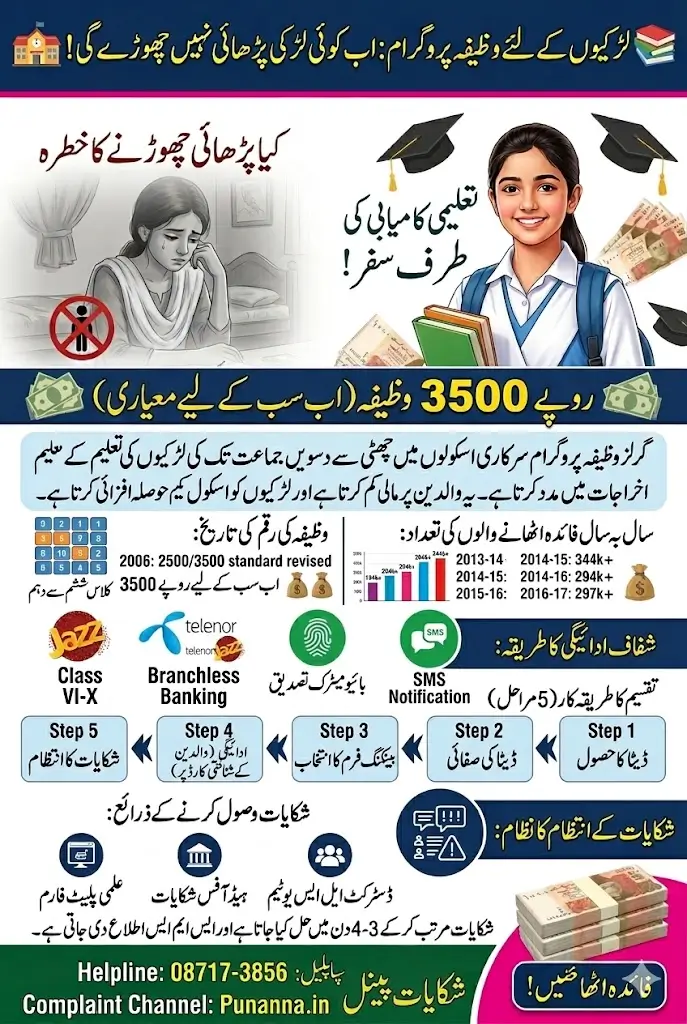
However, to create fairness and equal opportunities, the policy was later revised. Now, all beneficiaries receive Rs. 3500, regardless of their location.
Sindh Farmer Support Program: Full Details on the Benazir Hari Card Scheme
Year-wise Distribution of the Girls Stipend Program
The Girls Stipend Program has supported a large number of female students over the years. The number of beneficiaries in different academic years is shown below:
- 2013–2014: 344,744 beneficiaries
- 2014–2015: 294,308 beneficiaries
- 2015–2016: 280,000 beneficiaries (in process)
- 2016–2017: 278,000 beneficiaries (in process)
These numbers highlight the large impact of the program in helping girls continue their education.
Procedure of Girls Stipend Program Distribution
The Girls Stipend Program follows a clear and structured procedure to ensure smooth distribution of funds.
Step 1: Data Collection
Information about girl students is collected from schools through SAP forms by the district LSU teams.
Step 2: Data Entry and Cleaning
The collected data is entered and verified. Recently, an innovative OCR/ICR scanning method has been introduced to improve accuracy and efficiency.
Step 3: Hiring a Service Firm
A branchless banking firm is selected through the Expression of Interest (EOI) process to manage stipend distribution.
Step 4: Payment Disbursement
The stipend is transferred through the CNIC of the parent or guardian of the beneficiary.
Step 5: Complaint Management
If any issues occur, a complaint management system handles them to ensure that beneficiaries receive their payments.
Complaint Management System
The Girls Stipend Program has an organised complaint management system to address issues quickly and effectively.
Complaints are received through three main channels:
- District LSU Teams – This is the main channel for receiving complaints.
- Head Office Complaints – Beneficiaries can register complaints directly in person.
- ILMI Platform – Another channel used for submitting complaints.
All complaints are compiled twice a week. After reviewing and correcting the issues, they are sent to the service provider’s head office for correction and re-disbursement.
Usually, the problem is resolved within 3 to 4 days. Once the complaint is resolved, an SMS notification is sent to the beneficiary.
Relief for Motorcyclists in Khyber Pakhtunkhwa: Rs 22 Billion Package Announced by Sohail Afridi
Common Types of Complaints
Some common issues reported by beneficiaries include:
- Incorrect digits in CNIC numbers
- Expired CNIC
- Thumb impression mismatch during biometric verification
- Death of the father or guardian
- Parent or guardian living outside the city or country
- Not receiving the SMS notification
The complaint management system works to resolve these issues so that the stipend reaches the rightful beneficiary.
Conclusion
The Stipend Program is an important initiative that supports female education by removing financial barriers. By providing financial assistance to girl students from Class VI to Class X, the program encourages families to keep their daughters in school.
Through improved payment systems, transparent verification methods, and an effective complaint management system, this program continues to empower thousands of girls. It not only reduces dropout rates but also increases the transition of female students to higher education levels.
By investing in girls’ education today, the program contributes to building a more educated, empowered, and prosperous society in the future.