

The government of Sindh has approved a major Sindh Austerity and Petrol Conservation Plan aimed at reducing government spending, conserving fuel, and managing economic pressures caused by uncertainty in global energy markets.
The decision was taken during a cabinet meeting chaired by Sindh Chief Minister Murad Ali Shah in Karachi. The meeting included provincial ministers, advisors, special assistants, and senior administrative officials.
The plan introduces several measures related to fuel conservation, fiscal discipline, education, governance reforms, agriculture, and social protection. According to the provincial government, these steps are designed to ensure efficient use of resources while maintaining essential public services across the province.
Key Austerity Measures Approved by the Sindh Cabinet
Reduction in Government Vehicles and Petrol Usage
One of the most important parts of the Sindh Austerity and Petrol Conservation Plan is the reduction in the use of government vehicles and petrol consumption.
Under the new policy:
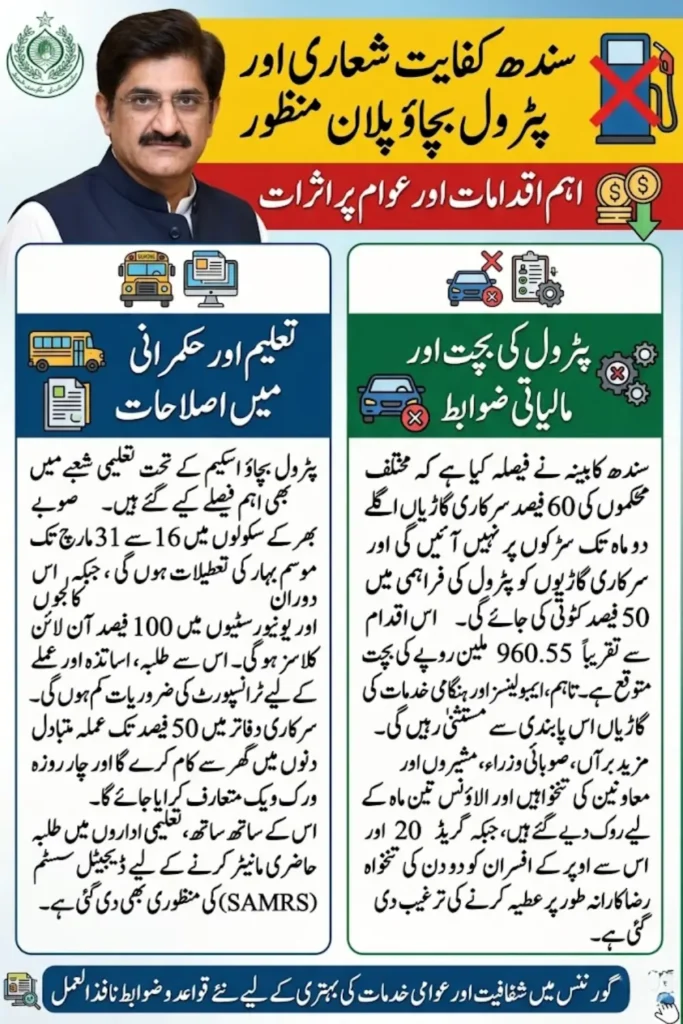
- 60 percent of government vehicles belonging to different departments will remain off the road for the next two months.
- Petrol supply to government vehicles will be reduced by 50 percent during this period.
This step is expected to save approximately Rs 960.55 million for the provincial government. However, operational vehicles such as ambulances, buses, and emergency service vehicles will not be affected by this restriction.
Government departments have also been directed to encourage car sharing among officers in order to reduce unnecessary travel and fuel usage.
Salary Cuts and Voluntary Sacrifices by Officials
As part of the Sindh Austerity and Petrol Conservation Plan, senior government officials and elected representatives have agreed to make financial sacrifices during the current economic situation.
The cabinet announced that:
- Provincial ministers, advisors, and special assistants will not receive their salaries and allowances for three months (April, May, and June).
- A 25 percent reduction in the salaries of provincial assembly members has been proposed during the same period.
- Senior officers in Grade 20 and above who earn more than Rs 300,000 per month have been encouraged to voluntarily donate two days of their salary.
These measures are intended to demonstrate solidarity with the public during challenging economic times.
Reduction in Government Expenditure
Another major decision under the Sindh Austerity and Petrol Conservation Plan is the reduction of government spending.
The cabinet approved a 20 percent reduction in non-essential government expenditure for the last quarter of the current fiscal year. This move is expected to save more than Rs 12 billion.
However, certain essential expenses have been exempted from these cuts, including:
- Electricity bills of government departments
- Purchase of medicines and health-related supplies
This ensures that essential public services continue without interruption.
Operational Reforms and Fuel Conservation Policies
Ban on New Purchases and Foreign Visits
The Sindh government has also introduced strict financial discipline measures.
A complete ban on purchasing new government vehicles will remain in place until June 2026. In addition, the purchase of other durable goods has also been restricted unless absolutely necessary.
Government officials have also been instructed to limit foreign visits. Official international travel will only be allowed in unavoidable situations. Moreover, ministers and government officers traveling abroad must use economy class instead of business class.
Restrictions on Official Events
To further reduce expenses, the government has banned:
- Official dinners
- Large government ceremonies and formal events
However, receptions for visiting foreign delegations will still be allowed when necessary.
Departments have also been encouraged to hold meetings online through digital platforms instead of traveling for physical meetings. This step will help reduce transportation and accommodation costs.
Work From Home and Short Workweek Policy
To further reduce fuel consumption caused by daily commuting, the Sindh Austerity and Petrol Conservation Plan includes flexible working arrangements.
Under the new policy:
- Up to 50 percent of government staff will work from home on alternate days.
- A four-day workweek will be introduced for many public and private sector offices.
These measures will help reduce traffic congestion, fuel usage, and operational costs.
However, some sectors will not follow these restrictions. The following sectors will continue working as usual:
- Banking
- Industry
- Agriculture
These sectors are considered essential for economic activity.
Education Sector Measures Under the Petrol Bachao Scheme
The Sindh government has also introduced measures for the education sector under the Petrol Bachao Scheme, which aims to reduce fuel consumption related to daily travel.
According to the decision:
- Schools across the province will observe spring vacations from March 16 to March 31.
- Colleges and universities will conduct 100 percent online classes during this period.
These steps will reduce transportation needs for students, teachers, and administrative staff.
Public Fuel Conservation Measures
In addition to government-level reforms, the cabinet has introduced several public measures to encourage fuel conservation.
Some of these measures include:
- Reducing speed limits on roads
- Limiting the number of guests at weddings and public gatherings
The new speed limits are:
- Motorways: 90–100 kilometers per hour
- Highways: 65–80 kilometers per hour
Lower speed limits can help reduce fuel consumption by vehicles.
The government has also limited the number of guests at weddings and large gatherings to 200 people. Authorities will also strictly enforce the one-dish law to discourage unnecessary spending and large-scale events.
Monitoring of Petrol Supply and Anti-Hoarding Measures
To ensure that fuel remains available to the public, the Sindh government has strengthened monitoring systems.
The provincial Energy Department is working closely with the Oil and Gas Regulatory Authority and the Ministry of Energy (Petroleum Division) to maintain a stable fuel supply across the province.
District administrations have been directed to:
- Conduct regular inspections
- Monitor fuel storage facilities
- Take strict action against hoarding and illegal storage of petroleum products
Chief Minister Murad Ali Shah emphasized that petrol hoarders must be kept under strict surveillance to prevent artificial shortages.
Digital Monitoring System for Schools
The cabinet also approved the Student Attendance Monitoring and Redress System (SAMRS) to improve education management in Sindh.
This system will introduce:
- A mobile application for monitoring student attendance
- A digital dashboard for school administrators and education authorities
The system will track admissions and daily attendance in schools managed by the Sindh Education and Literacy Department and other educational institutions.
The initiative aims to reduce student absenteeism and school dropout rates by identifying the factors that affect attendance.
Economic and Agricultural Policy Decisions
Amendments to Infrastructure Cess
The cabinet approved amendments to the Sindh Development and Maintenance of Infrastructure Cess Act after consultation with the business community.
The amendments aim to improve the collection and use of infrastructure cess. These funds are used to support development projects related to:
- Industrial infrastructure
- Transportation systems
- Provincial development programs
Wheat Release Policy to Stabilize the Market
To maintain stable wheat prices in the market, the government expanded the wheat release policy.
Under the revised policy:
- Wheat will be provided to licensed traders, flour mills, and chakkis.
- The government price has been set at Rs 8,000 per 100-kg sack.
Currently, about 300,115 metric tons of wheat are available for sale. The expected sales revenue from this stock is around Rs 30.398 billion, which will also help reduce the province’s wheat-related debt.
Women Agricultural Workers’ Rights
The Sindh cabinet also approved Sindh Women Agricultural Workers Rules 2026, prepared with the technical support of the International Labour Organization.
These rules formally recognize women working in:
- Agriculture
- Livestock
- Fisheries
Under the new policy, women agricultural workers will receive:
- Equal wages
- Maternity benefits
- Protection against harassment and discrimination
The government will also introduce Benazir Women Agricultural Worker Cards to register women workers.
In addition, a Benazir Women Support Program Endowment Fund will be established with an initial allocation of Rs 500 million to support women agricultural workers.
Health and Institutional Development
The cabinet approved the allocation of four acres of government land for the establishment of a nursing school connected to Hassan Suleman Memorial Hospital.
The hospital project will also receive $7.6 million (about Rs 2.14 billion) in financial support due to expansion of the under-construction building.
Once completed, the 312-bed hospital will provide advanced medical services to residents of Karachi and nearby districts.
Governance and Institutional Appointments
To strengthen public institutions, the cabinet approved several appointments and extensions.
These include:
- Appointment of Justice (Retd.) Irshad Ali Shah as Chairman of the Sindh Revenue Board Appellate Tribunal
- Appointment of Abdul Rahim Sheikh as Member (Agricultural Income Tax) in the Sindh Revenue Board
- Extension of Professor Syed Jamal Raza as Executive Director of Sindh Institute of Child Health and Neonatology
- Extension of Dr. Dar-e-Naz Jamal as Secretary of the Sindh Blood Transfusion Authority
New presiding officers were also appointed for anti-terrorism courts in several districts.
Conclusion
The Sindh Austerity and Petrol Conservation Plan represents a major effort by the provincial government to deal with economic challenges and fuel shortages. By reducing government spending, limiting petrol consumption, and introducing operational reforms, the government aims to maintain fiscal stability while ensuring that essential services continue.
Chief Minister Murad Ali Shah has directed district administrations across Sindh to ensure the strict implementation of these measures. The success of the plan will depend on effective monitoring, cooperation from government departments, and responsible use of resources by the public.
Punjab Union Councils Increased to 6,577 as Government Restructures Local Bodies