
CM Free School Meal Programme
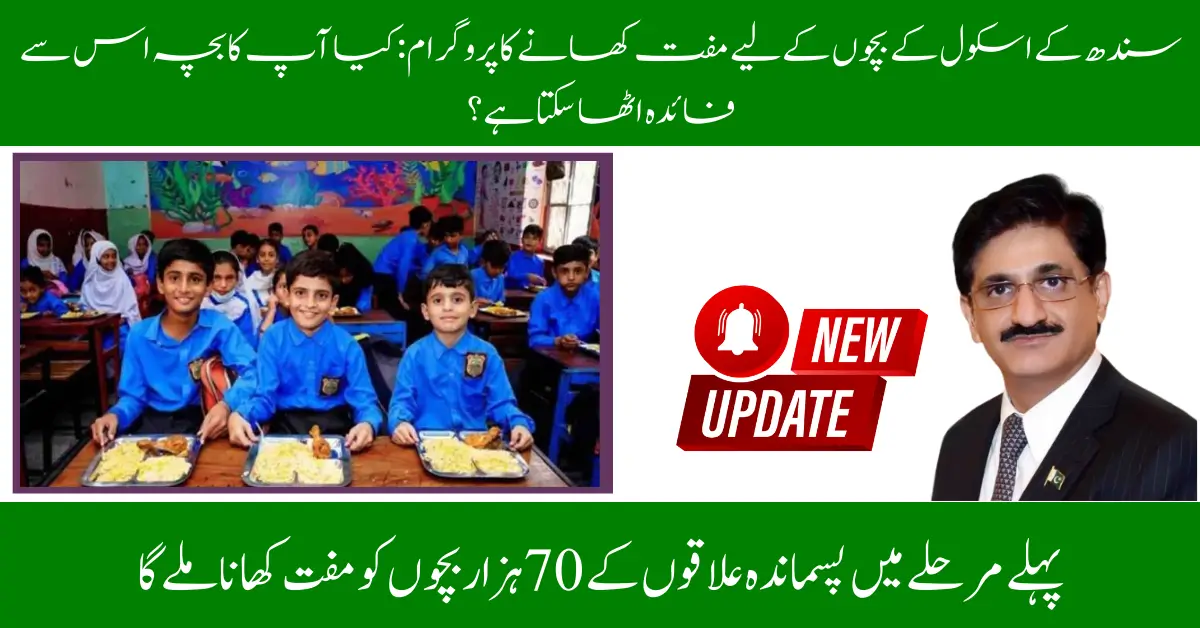
The Sindh government has launched the School Khana Program, under which children of government schools in underprivileged areas of the province receive one free, balanced meal every school day. Funded by the provincial government and run with the Allah Wale Trust, the initiative tackles malnutrition and food insecurity — and is expected to improve both children’s health and their academic performance. The program was launched by Sindh Education Minister Syed Sardar Ali Shah on 16 May 2025.
Official Launch of the Program
Sindh Education Minister Syed Sardar Ali Shah inaugurated the School Khana Program on 16 May 2025 at the Government Boys Primary School, Murad Memon Goth, District Malir, Karachi. The minister personally served food to the children at the launch, and 700 students of the school received a free meal that day. (No source supports the Chief Minister launching this program.)
Partnership for Improvement
This program has been launched in collaboration with the School Education & Literacy Department, Government of Sindh and a well-known welfare organization, the Allah Wale Trust. The provincial government provides the funding, while the Allah Wale Trust assists with food logistics, kitchen operations and meal distribution to ensure quality and transparency.
NADRA Introduces Self-Service Machines for ID Card Renewal and Re-Issuance
Nearly 100,000 Children Benefit in Initial Phase
In the first phase, the programme provides daily meals to nearly 100,000 schoolchildren in underprivileged areas, according to the official APP wire and reports in Dawn and The News (May 2025). The meals are prepared to meet children’s nutritional needs and support their physical and mental development.
Education and Nutrition are Closely Linked
Speaking at the inaugural ceremony, Education Minister Syed Sardar Ali Shah said that “the academic performance of children is directly related to their nutrition. If children do not get proper food, they cannot focus on their studies, and their learning capacity decreases.” Speaking at the launch, the minister said Pakistan ranks among the 10 poorest countries in the world, with about 42 per cent of the population living below the poverty line — and that in such circumstances, children’s health and education must be the top priority. (His launch-day remarks as reported by Dawn and APP; the “10 poorest” ranking is his claim, not an established fact.)
Future Expansion
During this event, it was also informed that the Sindh government will continue to extend the program to other districts and even to other deserving children. This initiative will not only improve the health of children but will also increase the attendance rate in schools, which has been a long-standing problem. Additional Secretary Dr Fauzia Khan said the programme’s impact would be evaluated on several parameters: students’ Body Mass Index (BMI) was recorded before the launch and would be recorded again after four months to monitor growth and health (The News, 18 May 2025).
BISP Check By SMS New Update – Online Registration
Role of Allah Wale Trust
Allah Wale Trust Chairperson Shahid Lone said 700 children at the Government Boys Primary School in Murad Memon Goth would receive one free meal daily, with plans to gradually expand to other schools. “A healthy, balanced meal is essential not just for physical development but also for learning,” he said (Daily Pakistan Global, 16 May 2025). Centralised kitchens prepare and deliver warm food at proper temperatures, with hand-washing facilities for students before and after meals (The News, 18 May 2025).
US$80 Million USDA–WFP Sindh School Meals Program (February 2026)
In February 2026, the Government of Sindh and the United States Department of Agriculture (USDA) launched a separate, much larger Sindh School Meals Program under USDA’s McGovern-Dole International Food for Education and Child Nutrition Program. Backed by US$80 million in USDA funding, it delivers daily cooked meals and take-home rations to more than 200,000 students across nearly 1,300 primary schools in Sindh, using US-provided commodities. It is implemented by Save the Children and the World Food Programme (WFP), in coordination with Sindh’s Planning and Development Department, School Education and Literacy Department, and the provincial Food and Health departments, aiming to improve enrolment, attendance and foundational learning. Thousands of teachers, headteachers, school management committee members and district officials are being trained in food safety, nutrition education and monitoring, and WASH facilities in targeted schools are being rehabilitated (WFP press release, 17 February 2026).
Rs578.39 Million WFP School Meals Pilot in Malir
Separately, the Sindh government and WFP co-financed a one-year School Meals pilot in District Malir for the 2025–26 academic year at a cost of Rs578.39 million. Decided at a meeting at the CM House between Chief Minister Syed Murad Ali Shah and WFP Country Director Coco Ushiyama, the pilot provides daily hot meals to 11,000 primary school students (up to grade five). The Sindh government contributes Rs462.71 million (80 per cent) and WFP Rs115.68 million (20 per cent). A centralised kitchen prepares meals of lentils, rice or bread, vegetables and a weekly serving of fruit, and the Sindh Food Authority oversees hygiene and nutritional standards (Dawn; The News; Business Recorder, May 2025). This is the initiative in which the Chief Minister was directly involved — it is distinct from the Allah Wale Trust School Khana Program above.
Conclusion
The Sindh School Khana Program is an important step for children’s education and health: free daily meals for nearly 100,000 schoolchildren in the first phase, with the 2026 USDA–WFP expansion and the Malir pilot taking school nutrition further. By removing hunger as a barrier to learning, it eases pressure on poor families and can lift attendance across the province.
See also: Punjab’s school meal and milk program and Sindh’s free midday meal coverage, plus more guides on 8171 BISP Information.