
Controversial Remarks About Women Drivers
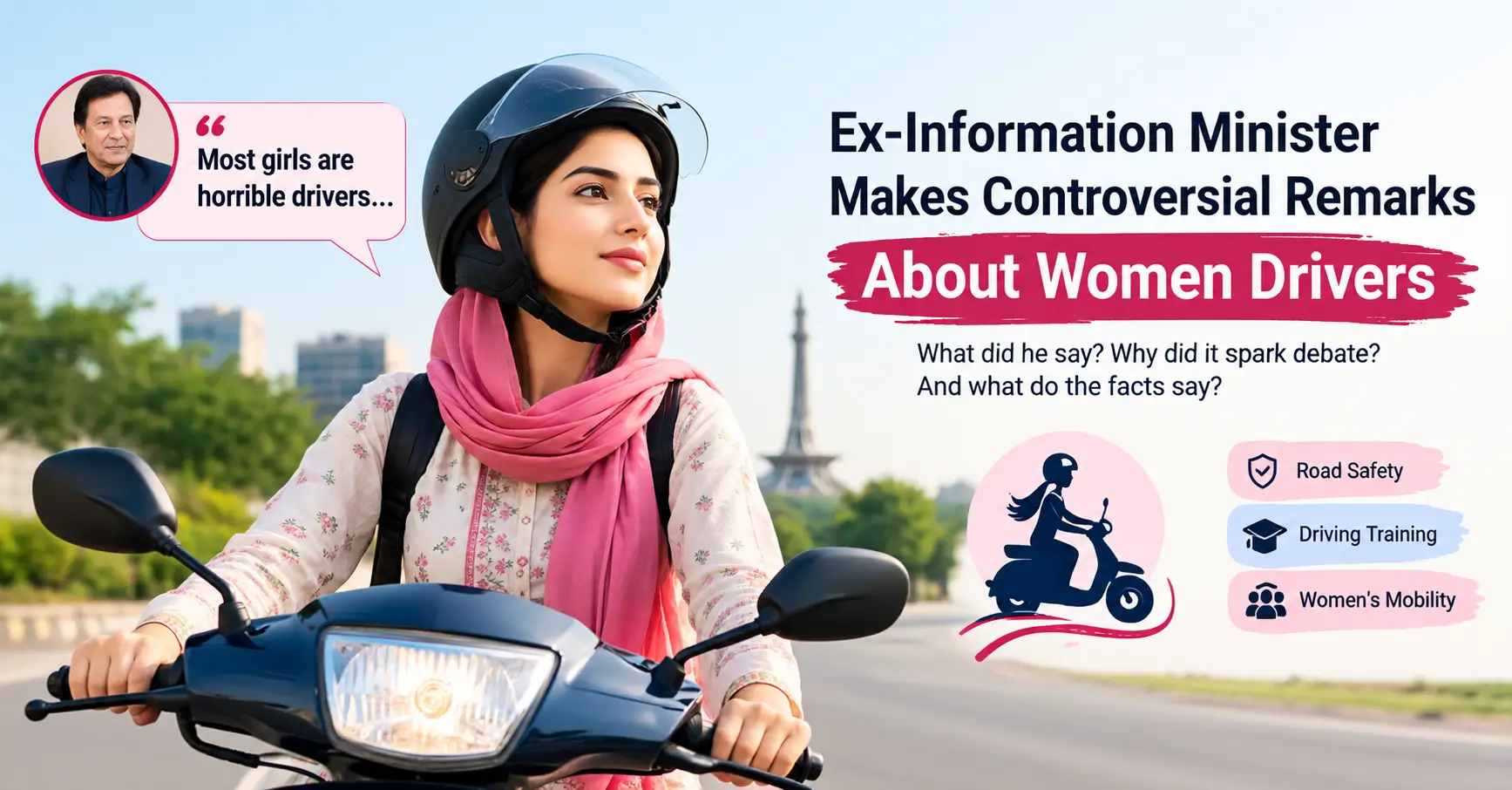
Former federal information minister Fawad Chaudhry has sparked a fresh debate on women’s mobility after making controversial remarks about women riding bikes and scooters in Pakistan.
On September 22, 2026, Chaudhry responded to a BBC News Punjabi report about the increasing use of scooters by women in Punjab. In his post on X, he claimed that “most of the girls are horrible drivers” and argued that women should not be encouraged to use bikes.
His remarks quickly attracted attention on social media, with users questioning the basis for the claim and discussing women’s right to travel independently. The comments have also renewed discussion about road safety, driving training and government initiatives aimed at helping women use scooters and other forms of transport.
What Did Fawad Chaudhry Say About Women Drivers?
Fawad Chaudhry made the remarks while responding to a report about women in Punjab increasingly using scooters for transportation.
In his September 22 post, he wrote that most girls were “horrible drivers” and said they should not be encouraged to use bikes because, in his view, doing so could put their lives and the lives of others at risk.
The statement was presented as Chaudhry’s own view. It should not be treated as an established fact about women drivers because no supporting official statistic was identified to substantiate his broad claim.
Multiple Pakistani news outlets reported the same statement and the reaction that followed.
Why Did the Remarks Attract Attention?
The controversy comes at a time when women’s use of scooters and motorcycles is receiving greater attention in Pakistan.
Women in different parts of the country have increasingly turned to two-wheelers for commuting, particularly where public transport is inconvenient or expensive. Supporters of women’s scooter use often describe independent transportation as a practical way to improve access to education, employment and everyday activities.
Following Chaudhry’s post, social media users questioned whether there was reliable data behind his statement. Some users also raised the broader issue of road safety and argued that driving ability should be assessed using evidence and individual driving behaviour rather than gender.
Dawn and other outlets reported that users also questioned whether statistics existed to support the former minister’s statement.
What Was the Context Behind His Statement?
The remarks came after a BBC News Punjabi report highlighting women using scooters in Punjab and efforts to encourage greater mobility.
The report brought attention to women who ride scooters and to scooter-related activities intended to encourage more women to travel independently.
Chaudhry responded to that report by opposing encouragement for women to use bikes and linking the issue to road safety.
His response subsequently became the focus of separate news reports and social media discussion in Pakistan.
More related program
LESCO Grants Bonus to Employees: Complete Details, Amount, and Official Status (2026)
Complaints Against BISP Payment Deductors 2026 – How to Report Illegal Deduction
BISP Quarterly Payment Status Check Using New CNIC Method
Punjab Aghosh Programme 2026: Registration, Eligibility, Rs 38,000 Financial Assistance & Complete Guide
Is There Official Evidence That Women Are Worse Drivers?
The claim that women are generally “horrible drivers” is a statement made by Fawad Chaudhry, not an established government finding.
A review of relevant official Pakistani government material did not identify a .gov.pk source establishing that women as a group are worse drivers than men.
This distinction is important when reporting the controversy.
There is a difference between reporting what a public figure said and presenting that statement as a verified fact. In this case, the available evidence establishes that Chaudhry made the claim, but it does not establish the broader claim as a fact.
Road safety depends on factors such as training, licensing, knowledge of traffic rules, road conditions and individual driving behaviour. A person’s driving ability cannot automatically be determined from gender alone.
Government Initiatives Are Also Supporting Women Drivers
The controversy comes alongside several government initiatives involving women’s mobility and driving.
For example, the Sindh government launched a programme in March 2026 to provide electric scooters to women. According to Radio Pakistan, the programme included free driving training to help women travel safely and independently.
An earlier Radio Pakistan report said selected women receiving electric scooters would also receive road-safety guidance and scooter-riding training. The stated objective was to provide women with safer and more independent transportation.
These official initiatives show that women’s use of two-wheelers is not simply a social-media discussion. Government programmes have also addressed women’s mobility, training and access to transportation.
Punjab Is Also Expanding Opportunities for Women Drivers
Women’s participation in driving-related programmes is not limited to scooters.
In February 2026, Radio Pakistan reported that Punjab Chief Minister Maryam Nawaz distributed keys to women candidates under the Punjab e-Taxi Scheme. The report said that a 30 percent quota had been reserved for women under the scheme.
This provides another example of women being included in transportation and driving-related government programmes.
Fawad Chaudhry’s Earlier Remarks About Women
The latest controversy is not the first time in 2026 that Fawad Chaudhry’s comments about women’s professional or public roles have generated discussion.
In June, he made remarks questioning women’s decision to join the police force. Pakistani media reported criticism of those comments at the time.
His latest statement about women riding scooters has therefore been discussed in the context of his earlier remarks about women. ARY News and other outlets have reported both incidents.
Why Driving Training Matters
The discussion also highlights the importance of proper driving and road-safety training for everyone who uses Pakistan’s roads.
Instead of relying on assumptions about a particular group of drivers, road safety measures can focus on practical issues such as:
- Proper driving and riding training
- Valid driving licences
- Helmet use for motorcycle and scooter riders
- Following traffic signals
- Using indicators correctly
- Maintaining a safe speed
- Understanding road signs
- Respecting other road users
The Sindh government’s electric scooter programme is one example where riding training and road-safety guidance were included alongside the distribution of scooters.
What We Know About the Controversy
The key facts surrounding the story are straightforward.
Fawad Chaudhry made his comments on September 22, 2026, while responding to a report concerning women using scooters in Punjab. He said that most girls were poor drivers and argued against encouraging them to use bikes.
The statement generated reactions on social media, including questions about the evidence supporting his claim.
At the same time, official government sources show that provincial authorities have introduced programmes supporting women’s access to scooters and other transportation, including driving and road-safety training.
Therefore, Chaudhry’s statement should be understood as a controversial personal claim rather than an established government finding about women’s driving ability.
Frequently Asked Questions
What did Fawad Chaudhry say about women drivers?
Fawad Chaudhry said in a September 22, 2026 post that most girls were “horrible drivers” and argued against encouraging women to use bikes.
When did Fawad Chaudhry make the controversial remarks?
He made the remarks on September 22, 2026, while responding to a report about women increasingly using scooters in Punjab.
Why did Fawad Chaudhry’s statement become controversial?
The statement attracted attention because it made a broad claim about women drivers without citing supporting statistics. It also came amid growing government and public attention to women’s mobility and scooter use.
Is there official evidence that women are worse drivers?
No official .gov.pk source identified for this report establishes the broad claim that women are generally worse drivers than men. Chaudhry’s statement should therefore be treated as his own claim rather than an established fact.
Are Pakistani governments supporting women who want to ride scooters?
Yes. For example, the Sindh government has launched an electric scooter programme for women that includes driving training and road-safety guidance. Punjab has also included women in transportation initiatives such as its e-Taxi Scheme.
Final Words
Fawad Chaudhry’s latest remarks about women drivers have opened another discussion about women’s mobility, road safety and driving standards in Pakistan.
While his statement has been widely reported, there is an important distinction between what he claimed and what official evidence establishes. Government initiatives in Sindh and Punjab show that women’s access to transportation and participation as drivers are being addressed through programmes that also emphasize training and safety.
As the discussion continues, verified statistics, proper driving education and road-safety measures remain more useful for understanding driving behaviour than broad assumptions about any particular group of road users.