

National Youth Employment Policy
Pakistan is home to one of the youngest populations in the world, and turning that demographic strength into economic momentum has long been a policy priority. The National Youth Employment Policy (NYEP), rolled out under the Prime Minister’s Youth Program, is the government’s latest attempt to bridge the gap between education, skills, and real job opportunities — both inside Pakistan and abroad.
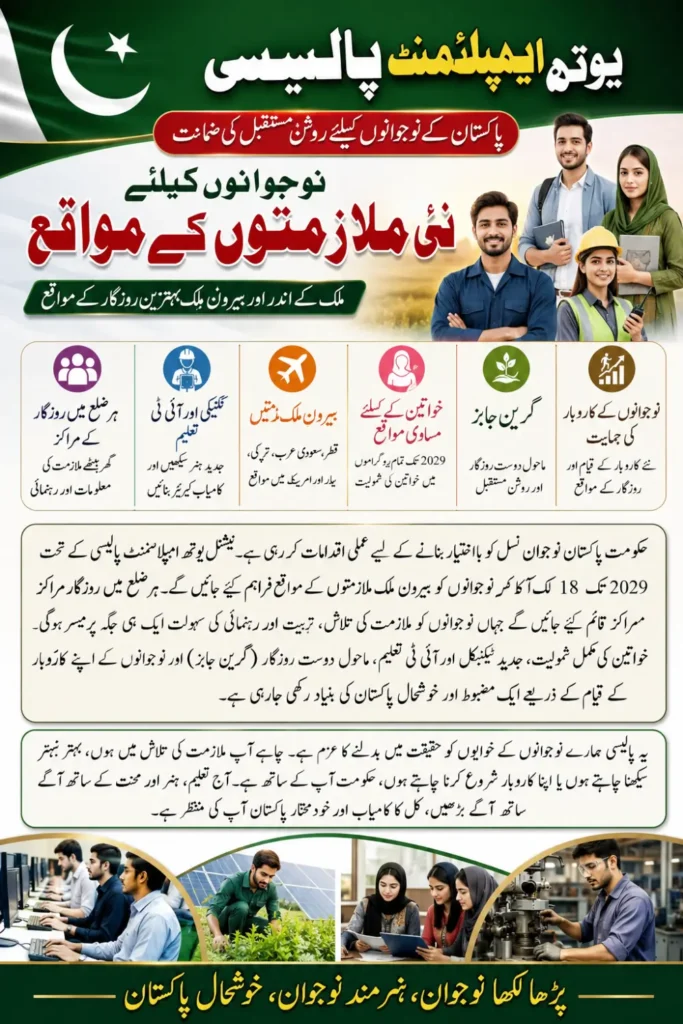
Rather than treating employment as a single issue, the NYEP takes a multi-pronged approach: overseas job placement, local employment facilities, gender-inclusive hiring, technical training, support for new businesses, and a push toward environmentally friendly jobs. Together, these pieces are meant to give young Pakistanis a realistic path toward stable careers.
What the Policy Actually Covers
1. Sending Skilled Workers Abroad
A central pillar of the NYEP is overseas employment. The plan is to help roughly 1.8 million young Pakistanis find jobs in countries such as Qatar, Saudi Arabia, Turkey, Belarus, and the United States by 2029. Before departure, candidates will go through language courses and technical training so they can meet the standards expected in these labor markets — improving both their employability and their long-term prospects overseas.
2. Bringing Jobs Closer to Home
Not everyone wants to — or can — move abroad, which is why the policy also focuses heavily on domestic job creation. Employment exchanges are planned for every district in the country, functioning as one-stop centers where job seekers can browse listings, get counseling, and apply for positions without traveling to major cities. The goal is simple: reduce the pressure on people to relocate just to find work.
3. Making Room for Women in the Workforce
Gender inclusion is written directly into the policy’s targets. By 2029, women are expected to be represented across all employment programs under the NYEP. This isn’t just a symbolic commitment — it’s meant to open doors for women in sectors and roles that have traditionally been harder to access, while also supporting broader financial independence and participation in economic decision-making.
4. Building Technical and IT Skills
To keep pace with global hiring trends, the policy places strong emphasis on technical education and IT training. A committee chaired by the Prime Minister reviews progress on this front every two months, adjusting programs as needed. The idea is to produce a workforce that’s genuinely competitive internationally, not just locally employable.
5. Backing Young Entrepreneurs
Job creation isn’t limited to placing people into existing roles — the NYEP also wants to grow new businesses. Ten new youth-led enterprises are planned for registration under the initiative, reflecting a broader push to turn young Pakistanis into employers as well as employees.
6. Green Jobs and Social Reintegration
The policy also carves out space for environmentally sustainable employment — so-called “green jobs” — tying economic opportunity to Pakistan’s environmental challenges. Alongside this, there’s a social welfare component aimed at helping youth who have been involved in harmful activities reintegrate into productive roles in society.
Why This Matters
None of these components works in isolation. Overseas employment can bring in remittances and new skills; local employment exchanges cut down migration pressure; women’s inclusion widens the labor pool; technical training raises the overall skill ceiling; entrepreneurship support creates jobs rather than just filling them; and green jobs align economic growth with environmental responsibility.
If implemented as planned, the NYEP could reshape how young Pakistanis enter the workforce — offering more structured, supported pathways instead of leaving job searches to chance. The real test, as with most policies, will be in execution: how quickly employment exchanges open, how consistently training programs run, and how closely the 2029 targets for overseas jobs and women’s inclusion are actually met.