
QR-Based Authentication in Pakistan National Identity System
Pakistan has taken a major step toward digital transformation under the vision of “One Nation – One Identity.” Through recent amendments to the National Identity Card Rules 2002 and Pakistan Origin Card Rules 2002, the government has introduced significant reforms to modernize and strengthen the country’s identity framework.
These amendments were issued under Section 44 of the NADRA Ordinance 2000 and published in the Gazette of Pakistan on 24 February 2026 through S.R.O. 330(I)/2026 and S.R.O. 331(I)/2026. The reforms focus on QR-based authentication in Pakistan national identity system, stronger anti-fraud measures, expanded biometric verification, improved services for senior citizens, and updated identity card formats.
Let’s explore what these changes mean for citizens and the future of digital governance in Pakistan.
Legal Recognition of QR-Based Authentication
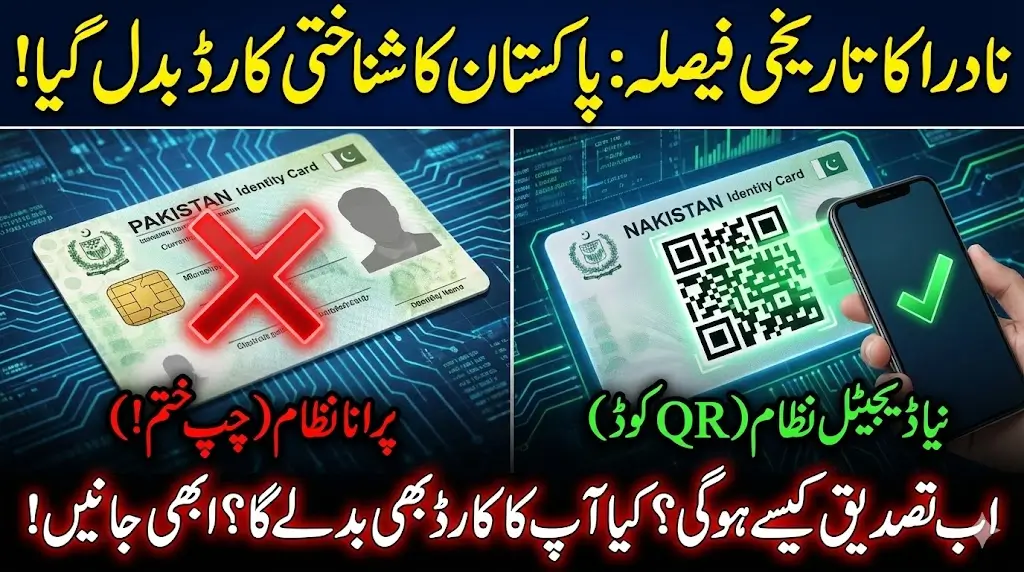
The most important reform is the official inclusion of QR-based authentication in Pakistan national identity system. For the first time, the law clearly defines the Quick Response (QR) code as a secure, machine-readable two-dimensional barcode that stores identity data and provides reliable verification when scanned.
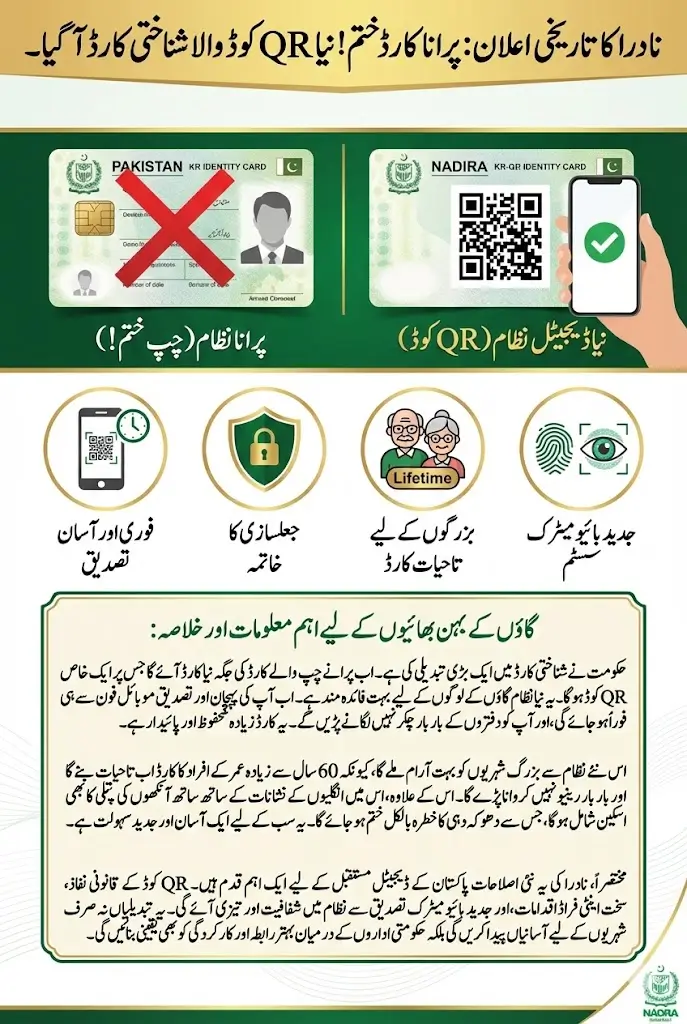
Previously, smart cards used microchips as a security feature. Under the new amendments, the rules now allow the use of a “QR code or any other technical feature” as an alternative to the microchip. This flexible legal approach ensures that NADRA will not need repeated amendments every time technology evolves.
This step also makes it possible to issue a single, uniform type of national identity card, instead of maintaining two separate types, one with a microchip and one without. This will simplify the system for both citizens and institutions.
Also read: Punjab Government’s New Facility: Driving Permit for Minors Aged 16–18
Strengthening Pakistan’s Digital Identity Ecosystem
The introduction of QR-based authentication in Pakistan’s national identity system strengthens the country’s broader digital ID infrastructure.
With QR-enabled credentials:
- Identity verification can be performed instantly at service delivery points.
- Institutions can verify the authenticity and status of a card through secure digital systems.
- Both online and offline authentication become faster and more reliable.
The reforms also enhance interoperability through the National Data Exchange Layer (NDEL). This digital backbone connects government departments and regulated sectors, allowing secure data sharing and coordination.
As a result, identity verification will become:
- Faster
- More transparent
- More consistent
- Less dependent on manual paperwork
This modernisation reduces errors and significantly lowers the risk of fraud and impersonation.
Also read: Maryam Nawaz Launches Chief Minister Dialysis Program Card: Free Treatment Worth Up to 1 Million PKR
Stronger Anti-Fraud and Suspension Mechanism
Another major improvement is the clarification of card suspension rules.
Under the amended rules, if a national identity card is suspended, all related authentication and verification services are immediately suspended as well. This means a suspended card cannot be used in any digital, institutional, or verification process.
This reform strengthens the integrity of QR-based authentication in Pakistan’s national identity system by ensuring that invalid or suspended cards cannot be misused. It creates a more secure environment for banks, government departments, and other service providers.
Expansion of Biometric Verification
The amendments also modernize Pakistan’s biometric framework. The rules now explicitly include:
- Fingerprints
- Iris scans
This reflects the adoption of a multi-modal biometric identification system. By combining multiple biometric features, the system increases accuracy and reduces the chances of identity fraud.
The inclusion of expanded biometrics further strengthens the reliability of QR-based authentication in Pakistan national identity system and ensures higher identity assurance standards.
Also read: Punjab Apni Chhat Apna Ghar Scheme: 3 Lakh Applications, Merit-Based Loans Announced
Lifetime Smart Cards for Senior Citizens
One of the most citizen-friendly reforms is the introduction of lifetime smart national identity cards for individuals aged 60 years and above.
This facility applies to both:
- Resident citizens
- Non-resident citizens
Senior citizens will no longer need to go through repeated renewal processes. The special mark indicating lifetime validity will provide ease and dignity to elderly citizens.
This step reflects the government’s commitment to promoting civic convenience while strengthening digital governance.
Standardized Identification for Residents of Azad Jammu and Kashmir
The amended rules make it mandatory for residents of Azad Jammu and Kashmir to have the words “Resident of Azad Jammu and Kashmir” clearly mentioned on their identity cards.
This measure ensures standardized geographical identification across the national database and reduces inconsistencies in documentation.
Updated Smart Card Formats with Modern Security Features
The schedules of the rules have been completely updated to introduce new smart identity card formats. These updated formats cover various categories, including:
- Resident citizens
- Overseas Pakistanis
- Child Registration Certificates
- Persons with disabilities
- Organ donors
- Combined categories
- Residents of Azad Jammu and Kashmir
All new card designs prominently incorporate QR codes and modern security layouts, establishing a standardized and future-ready identity document system.
Also read: PM Apna Meter Apni Reading App Launched to Prevent Overbilling and Digitize Power Bills
Impact on Digital Governance in Pakistan
The introduction of QR-based authentication in Pakistan national identity system is more than just a technical upgrade. It represents a major shift toward integrated digital governance.
Key long-term benefits include:
- Stronger legal and technical foundations for digital identity
- Improved coordination among government agencies
- Reduced fraud risks through instant suspension enforcement
- Enhanced biometric security
- Faster and more transparent service delivery
- Greater convenience for senior citizens
Through these reforms, Pakistan moves closer to a fully connected and digitally empowered governance system.