
CNIC, NICOP and POC
Most Pakistanis only ever deal with one identity document in their life, the CNIC. But NADRA actually issues three different cards, and if you live abroad or have family ties outside Pakistan, sooner or later you’ll run into the other two: NICOP and POC.
People mix these up constantly, and honestly, it’s not hard to see why, the names sound similar and the rules aren’t explained anywhere in plain language. So here’s a breakdown of what each card actually does, who qualifies, and what paperwork you’ll need.
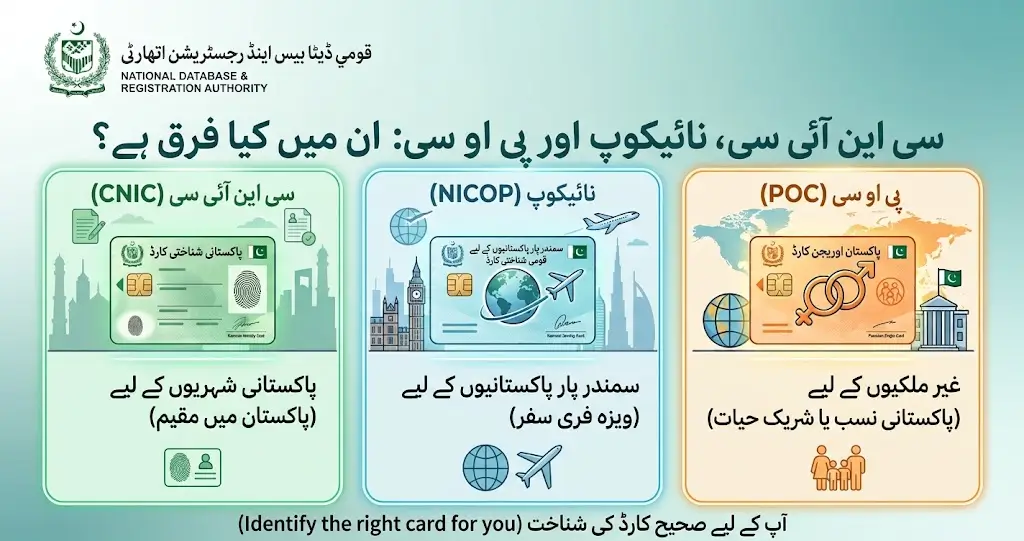
The Basic Difference Between CNIC, NICOP and POC
| Card | Who It’s For | Main Purpose |
|---|---|---|
| CNIC | Pakistani citizens living inside Pakistan | Day-to-day identity verification |
| NICOP | Overseas Pakistanis (living abroad or planning to) | Visa-free travel to Pakistan and full civic rights |
| POC | Foreign nationals with Pakistani ancestry, or those married to a Pakistani citizen | Visa-free entry and stay in Pakistan, without full citizenship status |
All three fall under the NADRA Ordinance 2000, but the law was written with a specific gap in mind: not every Pakistani lives inside Pakistan, and a single card couldn’t realistically cover someone studying in London the same way it covers someone living in Lahore.
ALSO READ
NADRA Launches Pakistan-Made QR Code National ID Card, Ending Chip Dependency
Who Is NICOP For?
NICOP stands for National Identity Card for Overseas Pakistanis, and it exists for exactly that, people who live outside the country, or are about to. In practice this usually breaks down into three kinds of applicants:
- Students who end up spending years abroad, especially for a Bachelor’s, Master’s, or PhD.
- Workers, a huge chunk of whom are labourers in the Middle East or Malaysia. They’re not citizens of those countries, just residents on a work visa, and they eventually come back.
- Dual citizens people who’ve taken citizenship of a country that has a dual-nationality agreement with Pakistan, like the US or UK, and want to hold onto their Pakistani status too.
The main perk of holding a NICOP is that you skip the visa entirely. You just show it at the FIA counter on arrival, and you’re in, after that, you handle your affairs in Pakistan the same way any other citizen would.
Documents Required to Get a NICOP
Before anything else, you have to prove you’re actually an overseas Pakistani, and what “proof” means changes depending on where you were born.
- Born outside Pakistan? You’ll need proof of birth abroad, plus something showing you’re the child of parents who still hold Pakistani citizenship.
- Born in Pakistan? A birth certificate is usually enough.
- Under 18? Nothing extra is needed, kids can just go by their parents’ registered address, no separate proof required.
One thing worth flagging: if your parents have already given up their Pakistani citizenship, getting a NICOP for their children gets messier. There’s usually extra paperwork involved, and it’s a situation a lot of families run into when they’re trying to bring kids back to Pakistan.
ALSO READ
Punjab Launches Its Biggest-Ever Shrimp Farming Project to Boost Blue Economy
Do You Actually Need to Visit a NADRA Office?
Not always, which is a relief for anyone abroad who doesn’t want to fly back just to submit paperwork. NADRA has pushed a lot of this online, and in many cases you can now apply straight through the Pak ID mobile app instead of standing in line. That said, verification sometimes still needs an in-person appointment or a trip to your nearest Pakistani embassy or consulate, this is more common for first-time applicants than for renewals.
POC vs NICOP: They’re Not the Same Thing
This is where most of the confusion happens. The two cards sound similar and both let you skip the visa, but they’re built for different people:
- NICOP is for actual Pakistani citizens who happen to live abroad, dual nationals or just long-term residents elsewhere.
- POC is for foreign nationals who aren’t Pakistani citizens at all, but have a link to Pakistan through ancestry or through marrying a Pakistani citizen.
So a NICOP holder is still legally a Pakistani. A POC holder isn’t, they just get the same visa-free access without full citizenship attached.
Final Thoughts
At the end of the day, CNIC, NICOP, and POC all exist to solve the same basic problem: how do you keep every person connected to Pakistan, whether they’re sitting in Karachi or Chicago, properly documented and able to access their rights. If you’re not sure which one applies to you or a family member, the safest first step is figuring out your exact category before you start gathering documents. And where the Pak ID app can save you a trip, use it.
Disclaimer: This article is for general information only. For anything official, applying, renewing, or checking eligibility — go through NADRA’s official channels or your nearest NADRA office directly.