

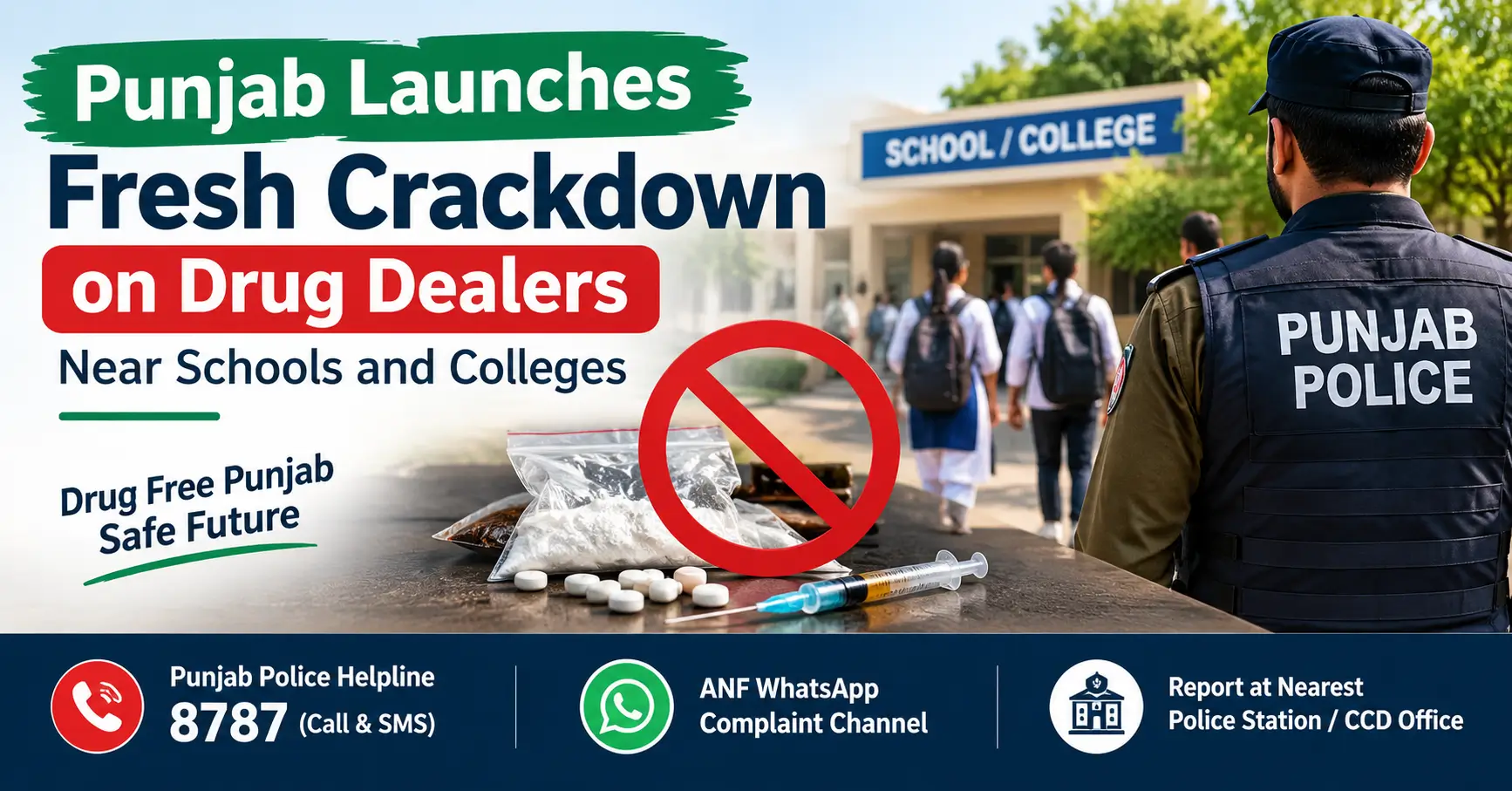
Crackdown on Drug Dealers
Punjab’s Crime Control Department (CCD) has ordered a province wide crackdown against the sale, purchase and use of narcotics, with a sharp focus on drug dealers operating close to schools, colleges and other educational institutions. The directive came from Additional Inspector General (AIG) CCD Punjab, Sohail Zafar Chattha, who instructed field officers to adopt a zero tolerance policy against anyone involved in the drug trade.
This is not an isolated order. It fits into a much larger, multi year campaign that Punjab Police has been running under the Chief Minister’s Drug Free Punjab vision, and understanding that bigger picture helps explain why this latest action matters for parents, students and everyday citizens across the province.
What the CCD Has Ordered
Under the new emergency action plan, the CCD has directed the following steps:
- Immediate legal action against drug dealers and suppliers found operating near schools, colleges, hostels and other educational institutions
- Regular monitoring of the areas surrounding educational institutions to keep students away from drug exposure
- Intelligence based operations targeting larger drug networks and supply chains, not just street level sellers
- A public appeal to parents and teachers to watch for changes in children’s behaviour and daily routines that could signal drug use
The CCD spokesperson also confirmed that citizens can report anyone involved in the sale or supply of narcotics without fear of exposure, since public cooperation is described as essential to removing the drug trade at its roots.
ALSO READ
Proof of Life Certificate Rejected by Bank: Complete Solution for Pensioners (2026)
The Bigger Campaign Behind This Order
This crackdown builds on an anti narcotics drive that Punjab Police has sustained for several years under the province’s Drug Free Punjab vision. Official police statements posted on the Punjab Police website show a consistent pattern of directives from the Inspector General of Police ordering daily search and combing operations specifically in and around educational institutions and hostels, alongside province wide raids on drug dealers.
The scale of these operations has been substantial. Punjab Police’s own figures, released through its official press releases. show tens of thousands of raids conducted in a single year, resulting in large numbers of arrests, criminal cases and drug seizures including charas, heroin, opium, methamphetamine (ice) and alcohol. Separately, the Anti Narcotics Force has worked jointly with Punjab Police. With hundreds of registered cases specifically involving drug sellers operating near educational institutes and hostels.
In other words, the CCD’s latest order is best understood as an intensification of an existing, ongoing enforcement drive rather than a brand new one time operation.
Legal Consequences for Drug Dealers Under Pakistani Law
Drug trafficking and dealing in Pakistan are prosecuted under the Control of Narcotic Substances Act, 1997 (CNSA), the country’s primary narcotics law. The Act sets out punishments that scale with the quantity of narcotics recovered from an accused person. According to the official text of the law published on the government’s Pakistan Code portal, penalties range from short imprisonment terms with modest fines for very small quantities, up to life imprisonment with fines running into millions of rupees for large-scale trafficking. The law also removes the option of remission or probation for those convicted of the more serious offences under the Act, meaning courts cannot reduce these sentences on the usual discretionary grounds.
This legal framework is what gives police crackdowns their teeth. A raid that leads to an arrest under the CNSA is not simply a warning; depending on the quantity and substance recovered. It can result in a lengthy prison sentence.
ALSO READ
CM Electric Bike Scheme: Complete Details, Eligibility, and How to Apply (2026 Update)
How to Report a Drug Dealer in Punjab
Citizens who want to report suspected drug dealing, including activity near a school, college or residential hostel, have a few official channels available:
| Channel | Details |
|---|---|
| Punjab Police Complaint Helpline | 8787, operational for calls and SMS |
| Anti Narcotics Task Force Helpline | WhatsApp chatbot for drug related complaints |
| Local Police Station | File a complaint in person at the nearest station or CCD office |
Reports can made without disclosing personal details to the accused party. And police have repeatedly stated that public tips are a key part of dismantling supply networks rather than only catching individual street sellers.
Advice for Parents and Teachers
Alongside the enforcement push, the CCD has specifically urged families and schools to stay alert. A few practical signs worth watching for include sudden changes in a child’s friend circle, unexplained absences from school, a drop in academic performance, unusual secrecy about daily activities, or unfamiliar people waiting near school gates. None of these signs confirms drug use on their own. But a pattern of several together is worth raising with school administration. If needed, report to the police helplines above.
ALSO READ
Frequently Asked Questions
Who ordered the latest crackdown on drug dealers in Punjab?
The action was ordered by Additional Inspector General Sohail Zafar Chattha, head of Punjab’s Crime Control Department, directing a zero-tolerance policy against drug-related activity across the province.
Does this crackdown only target areas near schools?
The emergency action plan gives special priority to the vicinity of educational institutions and hostels. But the CCD’s mandate covers drug enforcement across Punjab more broadly, working alongside Punjab Police’s existing anti narcotics operations.
What law is used to prosecute drug dealers in Pakistan?
Cases are prosecuted under the Control of Narcotic Substances Act, 1997. This sets quantity based punishments ranging from short prison terms and fines for small amounts up to life imprisonment for large scale trafficking.
How can I report a drug dealer in Punjab?
Citizens can call or SMS the Punjab Police helpline 8787, use the Anti Narcotics Task Force WhatsApp complaint channel, or report in person at the nearest police station or CCD office.
Is this a new operation or part of an existing campaign?
It is an intensification of the province’s long running Drug Free Punjab campaign. This has involved recurring directives and large scale raids over the past several years, rather than a standalone new initiative.