

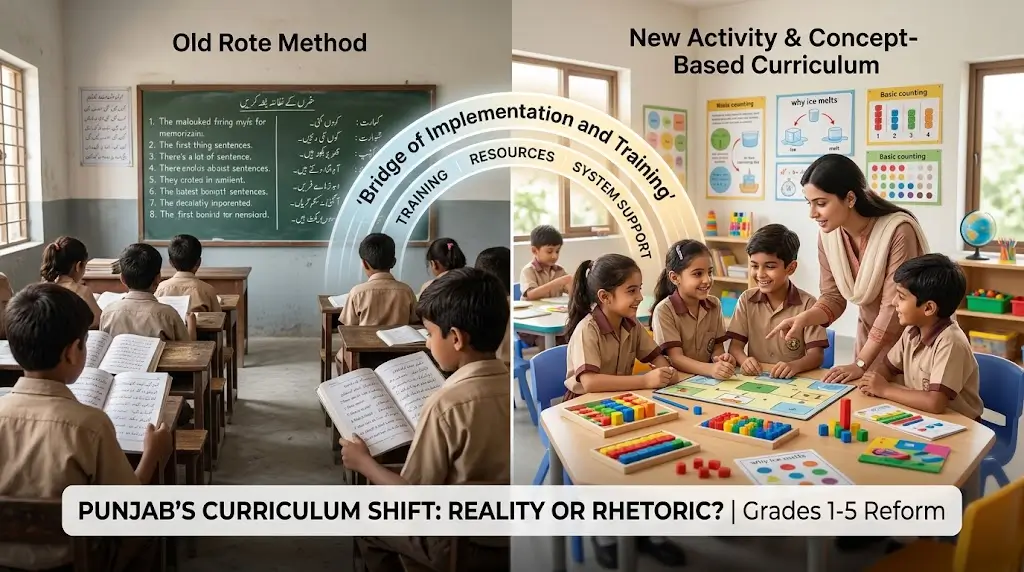
Punjab New Activity & Concept-Based Curriculum
Punjab has just rolled out a fresh curriculum for grades one through five, and this one comes with a different promise. Instead of pushing kids to cram facts and spit them back out on exam day, the new Activity & Concept-Based Curriculum wants children to think. To imagine. To notice patterns, ask “why,” and connect a lesson in a textbook to something happening in their own street or kitchen.
On paper, it’s a welcome shift. The question is whether it survives contact with an actual classroom.
What’s Changing in the Curriculum
According to available reports, textbooks built around this new framework won’t hit schools until the 2027 academic session. Until then, the plan is being finalized, and the core idea is simple to state but hard to execute: move away from rote memorization and toward genuine understanding.
Under the old model, a student could pass an exam by memorizing a paragraph without knowing what half the words meant. The new approach flips that. A child is expected to grasp why an answer is correct, how it was reached, and where that same idea shows up in daily life, whether that’s counting change at a shop or figuring out why ice melts faster on a hot day.
That’s not a small ask. It’s a completely different way of teaching, and a completely different way of learning.
ALSO READ
Pakistan to Roll Out 3,000 EV Charging Stations Nationwide by 2027
The Idea Is Sound, But Ideas Aren’t the Problem
Nobody seriously disagrees that concept-based learning beats rote learning. Education researchers have been saying this for decades. A child who understands a concept can apply it to problems he’s never seen before. A child who memorized a line can only repeat that exact line.
So the curriculum itself isn’t really up for debate. What is up for debate — and what Punjab’s education system has struggled with again and again, is delivery.
Punjab Has Been Here Before
This isn’t the first time the province has tried to reinvent how children are taught. Over the past several years, Punjab’s schools have gone through:
- Multiple curriculum revisions
- New textbook editions
- Changes to the examination and assessment system
- Renewed pushes toward “activity-based” teaching
- Various new instructional methods introduced and then quietly shelved
Each round arrived with the same hopeful headline: this time, things will be different. And each time, the reform ran into the same wall, the gap between what’s written in a policy document and what actually happens when a teacher walks into a room of fifty children with one whiteboard and no training on the new method.
A curriculum is only as good as the system built to deliver it. If teacher training, classroom resources, class sizes, timetabling, and follow-up monitoring are treated as afterthoughts, even the most thoughtfully designed curriculum will quietly fail — not because the idea was wrong, but because nobody set it up to succeed.
ALSO READ
Sindh Govt and NADRA Introduce Pakistan’s First Ever Senior Citizen Card
Ending Rote Learning Starts With Preparing the Teacher
Here’s the part that tends to get skipped in these announcements: a curriculum doesn’t teach itself. A teacher does.
If a teacher is simply handed a new set of concept-based textbooks with no real training, no guidance on activity-based teaching techniques, and no classroom materials to support it, they’ll likely fall back on what they already know — which is exactly the rote method this reform is trying to eliminate. At that point, the failure isn’t the curriculum’s fault. It’s an implementation failure.
For this reform to mean anything, teachers need:
- Structured training on how to actually run activity-based lessons, not a one-day workshop
- Ongoing classroom support, not a single briefing followed by silence
- Practical teaching materials, models, visual aids, low-cost activity kits — that match what the new books expect
- Realistic classroom conditions, since a teacher can’t run hands-on activities with 60 students crammed into one room
Every Child Doesn’t Learn at the Same Pace
There’s another factor that often gets lost in these policy conversations: not every five-year-old learns the same way, at the same speed, or under the same home conditions.
In primary classrooms especially, a child’s age, developmental stage, and local environment all shape how ready they are for concept-based learning. A student in an under-resourced rural school with no access to books at home is not starting from the same place as a student in a well-funded urban school.
Any new system needs enough flexibility to carry three different kinds of learners together:
- Struggling students, who need more repetition and support before a concept clicks
- Average students, who need steady, consistent reinforcement
- Advanced students, who need to be challenged rather than held back
A curriculum designed only for the “ideal” classroom will leave a large share of children behind.
ALSO READ
Hajj 2027 Applications Open: Complete Guide to Packages, Dues & Registration
The Real Test Is Still Ahead
Punjab’s new Activity & Concept-Based Curriculum is a step in the right direction on paper. Shifting from memorization to genuine understanding is exactly what education experts have been recommending for years. But good intentions and a good framework aren’t enough on their own.
The real test won’t be visible in 2027 when the new books are printed. It will show up a few years later, in whether teachers were properly trained, whether classrooms actually got the resources they needed, and whether the system built room for children who learn at different speeds.
Until those pieces are in place, the question isn’t really “is the new curriculum good?” It’s “is Punjab actually ready to deliver it?”