
MDCAT through govt testing agency from 2027
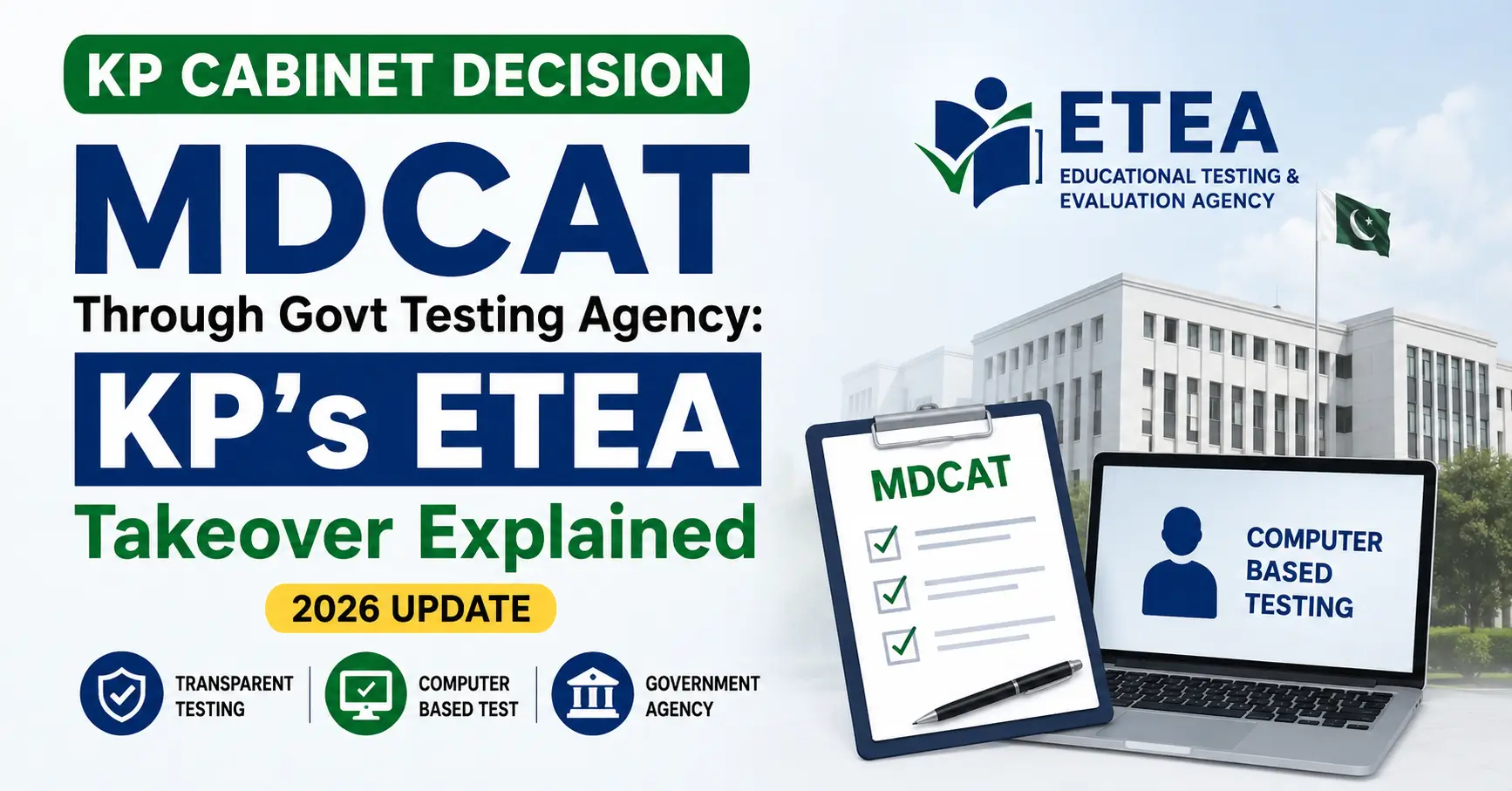
The Khyber Pakhtunkhwa (KP) government has approved a major policy shift: starting in 2027, the Medical and Dental Colleges Admission Test (MDCAT) in the province will be conducted through a government testing agency, the Educational Testing and Evaluation Agency (ETEA), instead of Khyber Medical University (KMU), which has run the test since 2024.
This guide breaks down what has actually been approved, why it matters, and what students and parents in KP need to know before the 2027 admission cycle.
What the KP Cabinet Actually Approved
On August 28, 2026, the KP cabinet, chaired by Chief Minister Sohail Afridi, approved holding MDCAT through ETEA starting from 2027 onward. Information Minister Shafi Jan told media that a committee has been formed to examine the technical and legal aspects of shifting the test from KMU back to ETEA.
Key points confirmed at the cabinet meeting:
- The decision applies from the 2027 admission cycle onward, MDCAT 2026 continues to be conducted by KMU as the current admitting university.
- A dedicated committee will study the technical and legal requirements of the transition before it is implemented.
- The move affects admissions to public and private medical and dental colleges within Khyber Pakhtunkhwa.
ALSO READ
NADRA Explains How Pensioners Can Re-Obtain Proof of Life Certificate
Why ETEA and Not KMU?
To understand this policy, it helps to know the recent history of MDCAT in KP.
2023: MDCAT conducted by ETEA was hit by a major cheating scandal. Investigators found organized networks using Bluetooth-enabled devices and micro earpieces inside exam halls, with 219 candidates caught using unfair means. The scandal triggered intervention from the Peshawar High Court and the Pakistan Medical and Dental Council (PMDC), and the exam had to be reconducted.
July 2024: Following the scandal, the KP Health Department formally notified KMU as the admitting university responsible for a “transparent and centralized” MDCAT for the province, a decision approved by the cabinet in June 2024. The 2024 and 2025 MDCAT exams under KMU were widely seen as transparent, with digital merit-list displays and no major controversies reported.
2026: Despite that track record, official working papers have proposed restoring MDCAT authority to ETEA. The stated justification rests on two points:
- ETEA originally held responsibility for MDCAT and similar entrance tests (including ECAT) for nearly 23 years before the 2023 scandal.
- The legal basis cited includes Section 4(1)(a) of the ETEA Ordinance, 2001, and the newly promulgated ETEA Act, 2026 (enacted May 4, 2026), which authorizes ETEA to conduct admission tests for professional colleges.
ETEA’s Executive Director, Adil Safi, has stated that under the new ETEA Act 2026, no other organization can legally conduct such examinations going forward, a technical/legal argument for the shift, separate from the performance question.
This history matters because it explains why the decision has drawn both support (legal mandate, institutional capacity) and criticism (concerns about repeating past irregularities) from different stakeholders.
ALSO READ
Proof of Life Certificate: What Pakistani Pensioners Need to Know
ETEA’s Current Testing Capacity
Government officials cited the following figures to justify ETEA’s readiness to take over MDCAT again:
| Metric | Figure |
|---|---|
| Registered CBT (Computer-Based Testing) centres | 60, across KP and other parts of Pakistan |
| Daily testing capacity | Up to 26,000 candidates |
| CBT system in operation since | September 2024 |
| Tests conducted under CBT so far | Over 1,300 |
| Candidates tested under CBT so far | Approximately 500,000 |
Officials argue that ETEA’s modern Computer-Based Testing infrastructure, introduced after 2023, offers a more secure and transparent format than the older paper-based system that was compromised in the 2023 scandal.
The Concerns Being Raised
Not everyone is convinced this is the right move. Reported concerns include:
- Undoing recent reforms: Since KMU took over in 2024, MDCAT in KP has run without major controversy. Critics argue there is no performance-based reason to change the conducting body now.
- Sunk investment: KMU has built dedicated examination management systems, monitoring arrangements, and merit-display infrastructure specifically for MDCAT over the past two years, which stakeholders worry could go unused.
- Institutional influence: Some sources allege that individuals connected to costly private medical institutions and networks that profited from the 2023 irregularities have lobbied for the shift back to ETEA, though this has not been independently confirmed by any government body.
- Public confidence: Given how intensely competitive medical college seats are in KP, education stakeholders stress that any change should prioritize credibility and transparency safeguards, not just legal or administrative convenience.
How MDCAT Actually Works Under National Rules
It’s worth understanding where provincial decisions like this fit into the bigger picture. Under the Pakistan Medical and Dental Council’s 2023 Admissions Regulations, each province (and Islamabad Capital Territory / Gilgit-Baltistan) designates an “Admitting University” responsible for conducting a single, centralized MDCAT for all public and private medical and dental colleges in that province, on dates approved by PMDC.
This is exactly the role KMU currently plays for KP, and the role ETEA is set to take over from 2027. Nationally:
- MDCAT is a mandatory requirement for admission to any MBBS or BDS program, public or private, anywhere in Pakistan.
- The standard merit formula prescribed by PMDC weighs MDCAT 50%, FSc/HSSC (Pre-Medical) 40%, and Matriculation/SSC 10%.
- Minimum HSSC eligibility is set at 60% marks or higher, as PMDC may notify from year to year, always check the current year’s official PMDC notification, since this threshold has been revised before.
- For 2026, KP’s MDCAT is still being conducted through KMU as the designated admitting university, alongside other provincial admitting universities such as UHS Lahore, Sukkur IBA, BUMHS Quetta, and SZABMU Islamabad.
This national framework is why the KP cabinet’s decision needed a dedicated legal/technical review, changing the “admitting university” for a province is a formal regulatory process, not just an administrative reassignment.
ALSO READ
Solar Consumers to Get Green Meters Faster After Power Division’s Latest Directive
Timeline at a Glance
| Year | Conducting Body in KP | Status |
|---|---|---|
| Up to 2023 | ETEA | Ended after cheating scandal |
| 2024 | KMU | Notified as admitting university (July 2024) |
| 2025 | KMU | Conducted without major controversy |
| 2026 | KMU | Current cycle, ongoing |
| 2027 onward | ETEA | Approved by KP cabinet, pending technical/legal review |
What This Means for Students and Parents
- If you’re appearing in MDCAT 2026, nothing changes, KMU remains the conducting body this cycle.
- If you’re targeting the 2027 admission cycle, expect ETEA to be the provincial testing authority in KP, subject to the technical and legal committee’s findings.
- Keep watching official channels, ETEA (etea.edu.pk), KMU, and PMDC (pmdc.pk / mdcat.pmdc.pk), for the formal notification once the transition committee completes its review. Since implementation details (test format, fee, centres) will be issued closer to the 2027 cycle.
- Don’t rely on unofficial test-prep sites for eligibility percentages or dates; these have shown inconsistencies in 2026. Always cross-check against the current PMDC notification.