
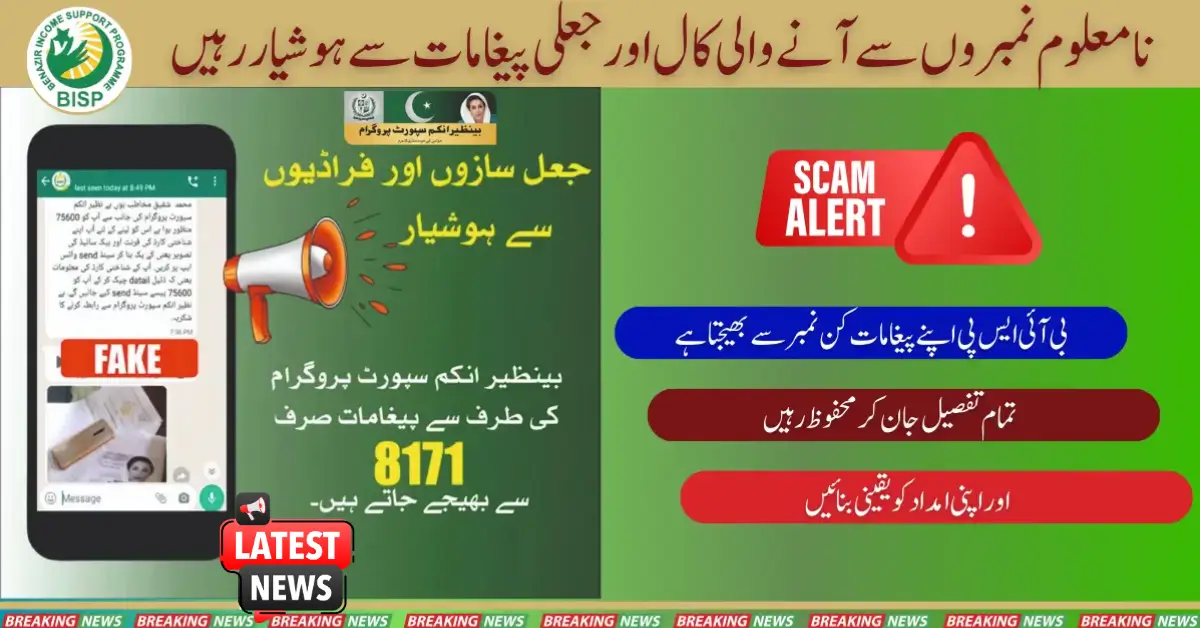
Avoid Calls or Messages Claiming to be from BISP
Scammers pretend to be from BISP and contact people through calls, SMS, or WhatsApp messages to steal their money. They often target simple, uneducated people who believe their words and send them money or share personal details. This alert explains how these fakers work and how you can protect yourself from them.
Their purpose is that the uneducated person who takes the call will get into their words and take money from them. Therefore, be safe from wrong messages or calls. If you receive a call or message from a number other than 8171, do not pick up this message or call, so that you can be aware of fraudsters.
These are fakers who send messages to extort money from others. So much money has come from your BISP. Please contact us at our WhatsApp number. If you contact the WhatsApp number, they will first tell you that you have received so much money, send us some money, and then we will deliver this money to your home. Then you understand that this message or call is wrong.
To avoid them, do not pick up a message or call from any number other than 8171, and you will be able to avoid fakers. Important alert: do not respond to calls or messages claiming to be from BISP. Stay safe by verifying all communications through official channels only.
Do Not Pick Up Calls From Any Number Other Than 8171
Stay alert and do not pick up calls from any number other than 8171. If you answer such a call, the caller will claim that your BISP money has arrived and ask you to send your ID card photo to their WhatsApp number. Never share your CNIC photo with unknown callers.
Then you understand that this message or call is wrong. If you send your ID card, they may do something to you trouble. That’s why, to avoid fraudsters, don’t pick up a call from any number other than 8171. You can be aware of fraudsters. Avoid Calls or Messages Claiming to be from BISP.
Roshan Ghrana Scheme For Electricity Consumers With 100 Units
Beware of the Wrong Message
Watch out for this fraud pattern: a message from any number other than 8171 claims that your BISP money has arrived and that BISP registered your number in the program. Then it asks you to contact the sender on their WhatsApp number. Treat every such message as fake.
If you receive such a message, know at once that it is fake and ignore the fraudsters behind it. If you follow their instructions, the scammer will ask you to send your National Identity Card number to their WhatsApp number. Or they will claim that you must first send money to their account before they release your BISP amount. This is completely wrong — never send them anything.
Do NOT delete a suspicious message right away. First, take a screenshot of it — including the sender’s number — and keep it as evidence. Then block the sender and report the message to the BISP helpline 0800-26477 or your nearest BISP tehsil office. Your report helps BISP block the scammer’s number.
Remember: BISP sends its program messages only through 8171.
Common BISP Scams to Watch Out For
Here are the most common scams reported by BISP beneficiaries in 2026. First, fake “payment approved” SMS: a message from a random mobile number claims your BISP payment is ready, with a link to “claim” it. Real 8171 messages never contain links — never tap them. Second, fake “BISP officer” calls: the caller asks for your CNIC number and demands a “registration fee” or “tax” through JazzCash or EasyPaisa before your payment is released. BISP never charges any fee and never asks for OTPs or PINs.
Third, WhatsApp “online registration 2026” links: messages promise to register you in BISP online. There is no online BISP registration — enrollment happens only through the NSER dynamic survey at BISP tehsil offices. Fourth, Facebook form scams: pages and posts ask you to fill forms with your CNIC and bank details for “new BISP programs”. Fifth, agent deductions: at payment points, some agents deduct a “commission” from your Rs. 14,500. Always count your full amount before leaving the counter.
Watch the amount quoted in any message or call: the current BISP Kafalat installment is Rs. 14,500. If an SMS or caller quotes a different amount — such as Rs. 25,000, Rs. 12,000, or Rs. 18,000 — treat it as a scam marker, keep the message as evidence, and report it.
Ehsaas Program Complete List Updated احساس پروگرامز لسٹ
In Case of a Wrong Message or Call, Complain to the BISP Office
If you receive any message or call from any number other than 8171, do not pick it up. If the message claims that your BISP money has arrived and asks you to contact their WhatsApp number, know at once that scammers sent it. Their only aim is to extort money from you.
Likewise, report any message or call from a number other than 8171 to the BISP office. Visit the center with your screenshot and file a complete complaint — the BISP office will then take action against the fraudster.
Where to Report a Scam: Official Helplines
Report scam messages and calls through these official channels: 1) BISP toll-free helpline 0800-26477 — call to report the sender’s number and get it blocked. 2) Your nearest BISP tehsil office — visit with a screenshot of the message to file a formal complaint. 3) PTA — forward scam SMS to 9000 to have the number blocked. 4) NCCIA (National Cyber Crime Investigation Agency) — file an online complaint at complaint.nccia.gov.pk for online and social-media fraud. 5) Police Helpline 15 — cybercrime can also be reported to the police helpline.
Beware of fake wallet-activation scams in 2026: with BISP payments moving to digital wallets, scammers send messages asking you to “activate” your wallet or share your PIN or OTP. BISP never asks for your PIN, OTP, or password by call, SMS, or WhatsApp — never share them with anyone.