

Punjab, New PLRA-FBR Cell Registry System
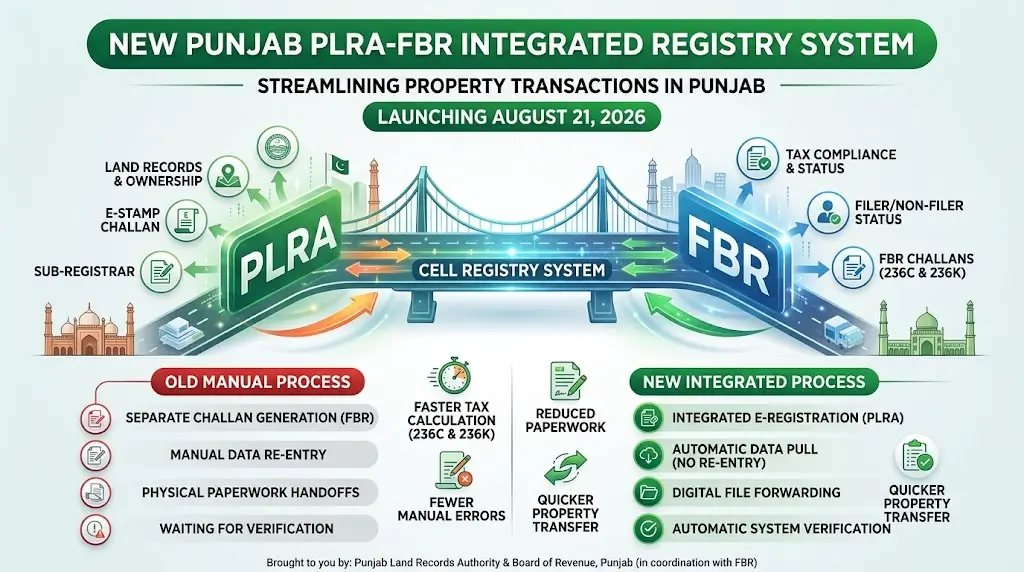
Buying or selling property in Punjab has always meant running between two separate offices: one for the FBR challan, and another for the actual registry at the Sub-Registrar. That’s about to change. Starting August 21, 2026, the Punjab Land Records Authority (PLRA) and the Federal Board of Revenue (FBR) are switching on a fully integrated digital system known as the Cell Registry, and it’s designed to remove most of that back-and-forth.
Here’s a plain-language breakdown of what’s launching, how the new process works, and what it means if you’re planning a property transaction anytime soon.
What Is the Cell Registry System?
The Cell Registry is essentially a data bridge between PLRA and FBR. Instead of a buyer or seller manually generating tax challans on one portal and then carrying that paperwork over to another, the two systems will now talk to each other directly. Land transfer records, ownership shares, buyer and seller details, and even green property certificate data will be pulled automatically once the process begins.
In short: less paperwork, less running around, and fewer chances for mismatched or duplicate records.
ALSO READ
نادرا کا نیا کیو آر کوڈ شناختی کارڈ: چِپ کے بغیر، مکمل ڈیجیٹل تصدیق
How the New Registration Process Works
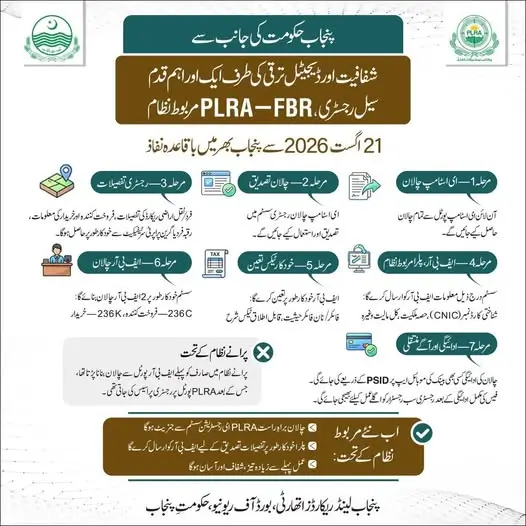
The updated system follows a clear, seven-step flow. Here’s what each stage involves.
Step 1: E-Stamp Challan
The process starts on the online e-stamp portal, where the required stamp challan is generated digitally rather than through a manual stamp paper process.
Step 2: Challan Verification
Once generated, the e-stamp challan is verified within the system before it can move forward into the registry workflow. This step is meant to catch errors early, before they cause delays later on.
Step 3: Registry Details
With the challan verified, the system automatically pulls in the land transfer record, along with buyer and seller information, per-person area share, and green property certificate details where applicable, all without anyone re-entering this information by hand.
Step 4: FBR-PLRA Linkage
This is where the two government systems formally connect. The linked system checks the transaction against FBR records to confirm tax status before moving ahead.
Step 5: Automatic Nexus Determination
The system automatically works out the connection between the property transaction and the applicable tax obligations, based on the data already collected in the earlier steps.
Step 6: FBR Challan Generation
Two separate FBR challans are generated automatically at this stage:
- One under Section 236C, which applies to the seller (advance tax on sale of immovable property)
- One under Section 236K, which applies to the buyer (advance tax on purchase of immovable property)
To make this happen, the seller shares basic details, CNIC number, share of ownership, and total transaction value, with FBR through the system. FBR then automatically determines the applicable filer/non-filer status and the corresponding tax rate, since non-filers and late filers pay noticeably higher rates than active taxpayers.
Step 7: Payment and Forwarding for Transfer
Once the challans are confirmed, payment is made and the file moves forward for the final transfer.
ALSO READ
Hajj 2027 Applications Open: Complete Guide to Packages, Dues & Registration
Old System vs. New System
| Old Process | New Integrated Process | |
|---|---|---|
| Challan generation | Done separately on the FBR portal first | Generated directly through the PLRA e-registration system |
| Payment | Paid via PSID through any bank’s mobile app | Same payment method, but tied directly into the registry flow |
| Data entry | Manual re-entry of buyer/seller details at each stage | Auto-pulled from linked FBR and PLRA records |
| Verification | Sent to Sub-Registrar only after full manual payment confirmation | Verification notice generated automatically within the linked system |
| Overall process | Slower, with more room for mismatched paperwork | Faster, more transparent, less duplication |
Under the earlier setup, a buyer or seller had to first generate a challan on the FBR portal, pay it through PSID on a banking app, and only then send the registry file to the Sub-Registrar for processing. That sequential, manual handoff is exactly what the new system is built to shorten.
Why This Matters for Buyers and Sellers
If you’ve registered property in Punjab before, you already know how much time gets lost chasing verification between departments. The Cell Registry addresses three practical pain points:
- Fewer manual errors, since data flows automatically between PLRA and FBR, there’s less risk of typos or mismatched CNIC and ownership details holding up your file.
- Faster tax determination, filer status and applicable rates under Sections 236C and 236K are calculated automatically, so there’s no guesswork about what you owe before payment.
- Quicker turnaround at the Sub-Registrar’s office, because verification happens within the linked system rather than through separate paper trails, files should move to the registry stage faster.
ALSO READ
Punjab New Activity & Concept-Based Curriculum: Will It Actually Fix Our Classrooms?
Who’s Behind the Rollout
The system is being implemented jointly by the Punjab Land Records Authority and the Board of Revenue, Government of Punjab, in coordination with FBR. As with most large digital government rollouts, it’s worth expecting some early hiccups, system integrations of this scale rarely go perfectly smooth in the first few weeks, so buyers and sellers with transactions planned around the launch date may want to build in a little extra time.
Frequently Asked Questions
When does the new Cell Registry system start?
It’s set to roll out across Punjab from August 21, 2026.
Do I still need to visit the FBR portal separately?
No. Under the new system, the challan is generated directly through the PLRA e-registration platform, so a separate FBR portal visit for challan generation is no longer necessary.
What are Sections 236C and 236K?
236C is the advance tax the seller pays on a property sale, and 236K is the advance tax the buyer pays on a property purchase. Both are calculated automatically under the new system based on your filer status.
Does filer status still affect my tax rate?
Yes. FBR automatically checks whether you’re a filer, late filer, or non-filer, and the applicable tax rate is adjusted accordingly, non-filers continue to pay a higher rate.
Will this speed up property registration?
That’s the intent. By linking data automatically instead of requiring manual challan generation and re-verification, the process is expected to move faster than the previous system, though actual results may vary during the initial rollout period.
Disclaimer: This article is based on publicly available information about the Punjab PLRA-FBR integrated registry system. For the most accurate and up-to-date guidance on your specific property transaction, consult the official PLRA and FBR portals or a registered property consultant.